
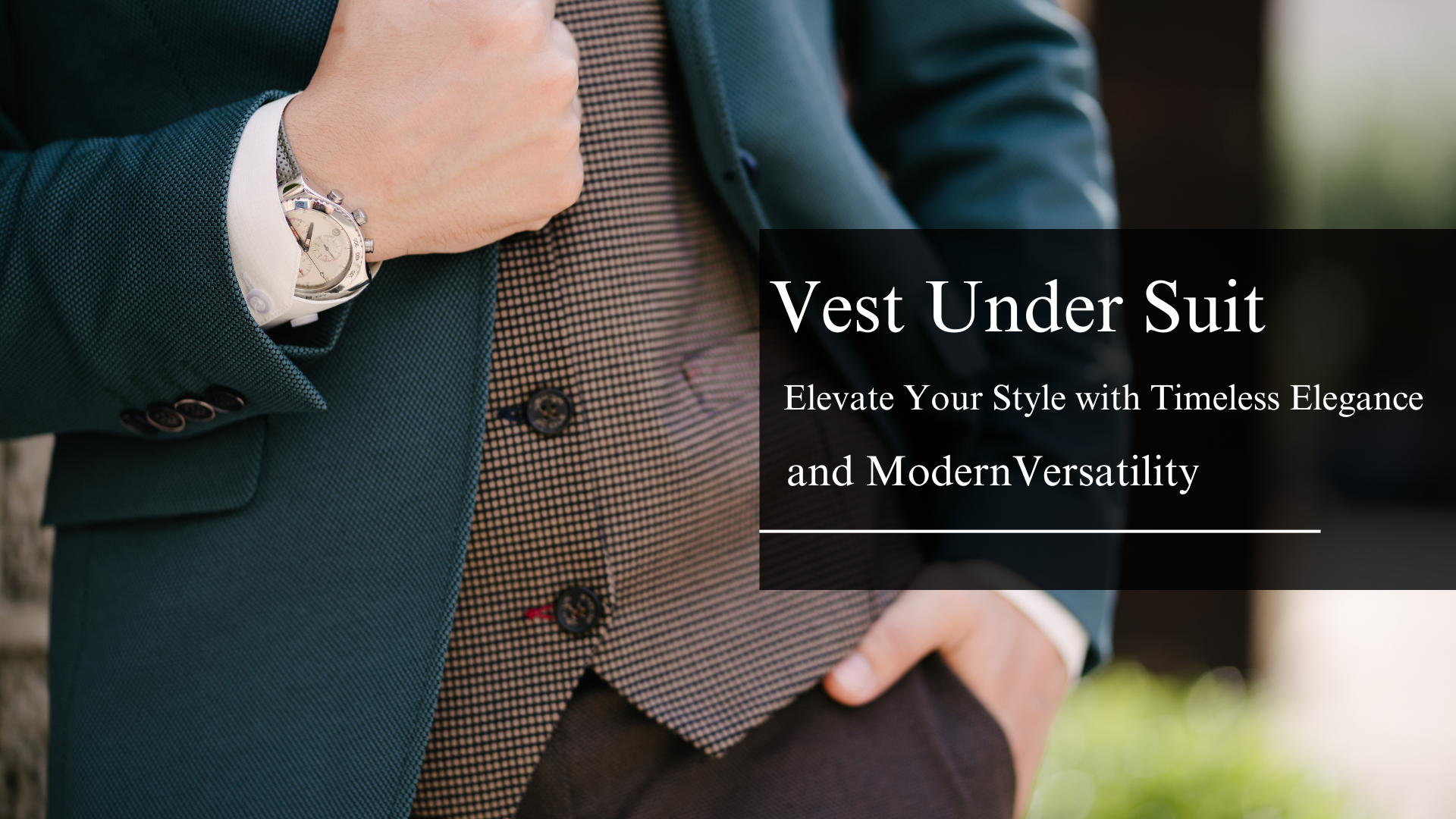
A well-tailored suit already creates a polished appearance, but adding a vest can give the outfit more structure, formality, and styling flexibility.
You can keep things traditional with a matching three-piece suit or introduce a contrasting colour, texture, or pattern for weddings and less conservative occasions. The key is making sure the vest looks like a natural part of the outfit rather than an extra layer added at the end.
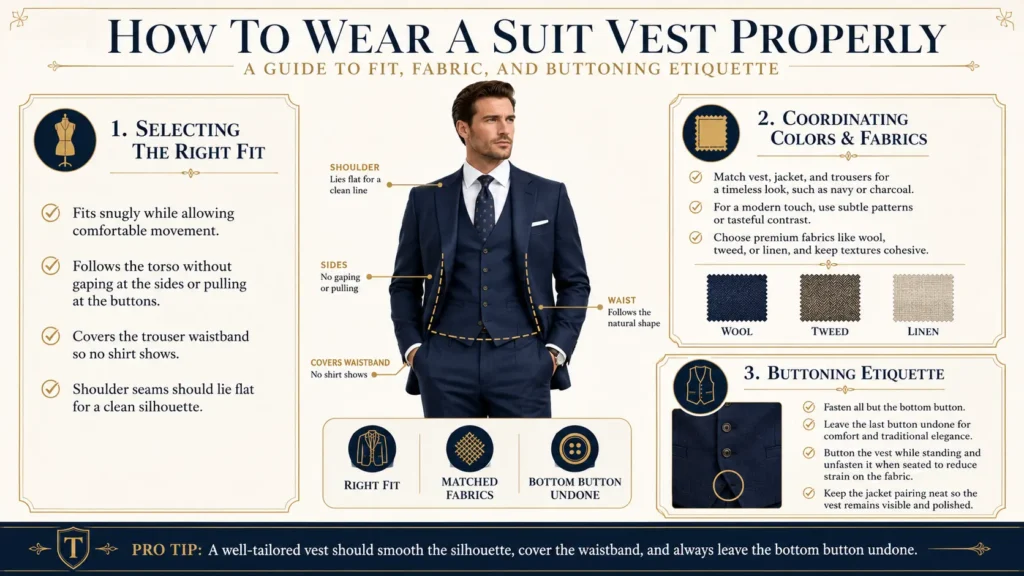
To wear a vest with a suit correctly, choose one that fits close to the body without pulling at the buttons. It should completely cover the trouser waistband, with no shirt showing between the vest and trousers. For a traditional three-piece suit, match the vest to the jacket and trousers, leave the bottom button undone, and keep the shirt, tie, and accessories coordinated.

What Are the Essential Rules for Wearing a Vest With a Suit?
The basic rules are straightforward:
- The vest should completely cover the trouser waistband.
- No shirt should show between the vest and trousers.
- Leave the bottom button undone on a traditional single-breasted vest.
- Choose a close fit without pulling or gaping.
- Match the vest to the suit for the most traditional three-piece look.
- Use contrasting colours carefully for weddings and less formal occasions.
- Make sure the jacket still closes comfortably over the vest.
- Keep the shirt neatly tucked and free from excess fabric.
- Avoid unnecessary bulk around the waist.
The most important rule is fit. Even the right colour and fabric will look wrong if the vest is too short, too tight, or hanging loosely from the body.
Why Wear a Vest With a Suit?
A vest is not essential for every suit, but it can change both the appearance and versatility of the outfit.
It Creates a More Formal Look
Adding a vest generally makes a suit look more deliberate and traditional.
A matching three-piece suit works particularly well for:
- Weddings
- Formal dinners
- Business occasions
- Ceremonies
- Professional events
It also means that if you remove your jacket later in the day, the outfit can still look structured rather than immediately becoming just a shirt and trousers.
It Adds More Styling Options
A matching vest keeps the outfit classic.
A contrasting vest can introduce another colour or texture, giving you more flexibility for weddings, social events, and creative tailoring.
The same three-piece suit can also be worn without the vest when you want a simpler two-piece look.
It Can Improve the Overall Silhouette
A properly fitted vest follows the torso and creates a cleaner transition between the shirt and trousers.
It should not function like compression wear or be pulled excessively tight. Instead, the vest should gently follow the shape of the body while remaining comfortable when standing and sitting.
How Should a Suit Vest Fit?

Fit is the most important part of wearing a vest successfully.
The Vest Should Sit Close Without Pulling
The fabric should follow the chest and waist without strong horizontal wrinkles.
If the buttons appear to pull apart, the vest is too tight.
If large amounts of fabric hang around the waist or chest, it is too loose.
The Waistband Should Be Fully Covered
The bottom of the vest should meet or slightly overlap the top of the trousers.
There should be no visible strip of shirt between the vest and trousers.
If shirt fabric is showing, the vest may be too short, the trousers may sit too low, or both.
The Armholes Should Sit Cleanly
The armholes should lie close to the body without cutting into the shoulders or creating large gaps.
Large gaps around the armholes can indicate that the vest is too large or needs more shaping through the chest.
The Neckline Should Lie Flat
The neckline should sit naturally against the shirt rather than standing away from the chest.
The Back Should Remain Smooth
Many vests have an adjustable strap at the back.
This can help fine-tune the fit, but it should not be pulled extremely tight to compensate for an oversized vest.
If tightening the adjuster creates strong wrinkles across the back, the vest probably needs proper alteration.
How Do You Wear a Suit Vest Properly?
The relationship between the vest, trousers, shirt, and jacket matters more than the vest alone.
Start With the Right Length
The vest should extend far enough to completely cover the trouser waistband.
This is one reason trouser rise matters in a three-piece suit. Mid-rise or higher-rise trousers generally work more naturally with a waistcoat than very low-rise trousers.
Keep the Shirt Smooth Underneath
A shirt with too much excess fabric can bunch beneath the vest and create unnecessary bulk around the waist.
The shirt should fit cleanly through the chest and waist before the vest is added.
Check the Jacket Over the Vest
Once the vest is in place, fasten the jacket and check that it still sits comfortably across the chest and waist.
If the jacket suddenly pulls or feels noticeably tighter, the vest may be too bulky or the jacket may need additional room.
Which Buttons Should You Fasten on a Suit Vest?
For a traditional single-breasted vest, fasten the buttons while leaving the bottom button undone.
This allows the lower part of the waistcoat to sit more naturally over the trousers and gives you slightly more freedom when moving or sitting.
Unlike a suit jacket, a classic waistcoat does not normally need to be completely unbuttoned every time you sit down.
If the vest becomes uncomfortable or pulls heavily across the stomach when seated, that may indicate that the fit is too tight.
Double-breasted waistcoats have a different construction and are generally worn more fully fastened.
Should the Vest Match the Suit?

For the most traditional three-piece suit, yes.
A matching vest uses the same cloth as the jacket and trousers.
For example:
Navy jacket + navy vest + navy trousers
or
Charcoal jacket + charcoal vest + charcoal trousers
This creates the most cohesive appearance and is usually the safest choice for:
- Business
- Formal weddings
- Professional events
- Formal dinners
- Ceremonies
If you are commissioning your first three-piece suit, matching all three pieces is usually the easiest place to start.
Can You Wear a Contrasting Vest With a Suit?

Yes. A contrasting vest can work very well when the colour, fabric, and level of formality still relate to the rest of the outfit.
Some easy combinations include:
- Navy suit with a light grey vest
- Charcoal suit with a medium grey vest
- Brown suit with a beige vest
- Navy suit with a muted burgundy vest
- Beige suit with a brown vest
Contrasting vests are particularly useful for weddings and social occasions where you have more freedom to introduce colour.
The goal is contrast, not competition. If the suit, vest, shirt, and tie are all strongly patterned or brightly coloured, the outfit can quickly become too busy.
What Are the Best Vest and Suit Colour Combinations?
| Suit Colour | Matching Vest | Contrasting Vest | Best Occasion |
|---|---|---|---|
| Navy | Navy | Light grey, tan, muted burgundy | Business, weddings |
| Charcoal | Charcoal | Medium grey, muted burgundy | Business, formal events |
| Light Grey | Light grey | Navy, charcoal | Daytime weddings |
| Black | Black | Deep grey | Evening and formal events |
| Brown | Brown | Beige, cream, olive | Autumn and outdoor events |
| Beige | Beige | Brown, soft blue | Summer and destination weddings |
Matching colours create the most traditional appearance.
Contrasting combinations work best when the overall outfit remains balanced and each garment shares a similar level of formality.
Should the Vest Fabric Match the Suit?

For a traditional three-piece suit, the vest should normally be made from the same cloth as the jacket and trousers.
This keeps the outfit cohesive.
Contrasting fabrics can also work, but they should make sense together.
For example:
Wool suit + wool vest
Classic and easy to coordinate.
Tweed suit + textured wool vest
Suitable for cooler weather and less formal tailoring.
Linen suit + linen or lightweight-blend vest
Better suited to warm-weather and destination weddings.
Avoid combining fabrics with completely different levels of formality unless the contrast is intentional.
What Is the Difference Between Single-Breasted and Double-Breasted Vests?
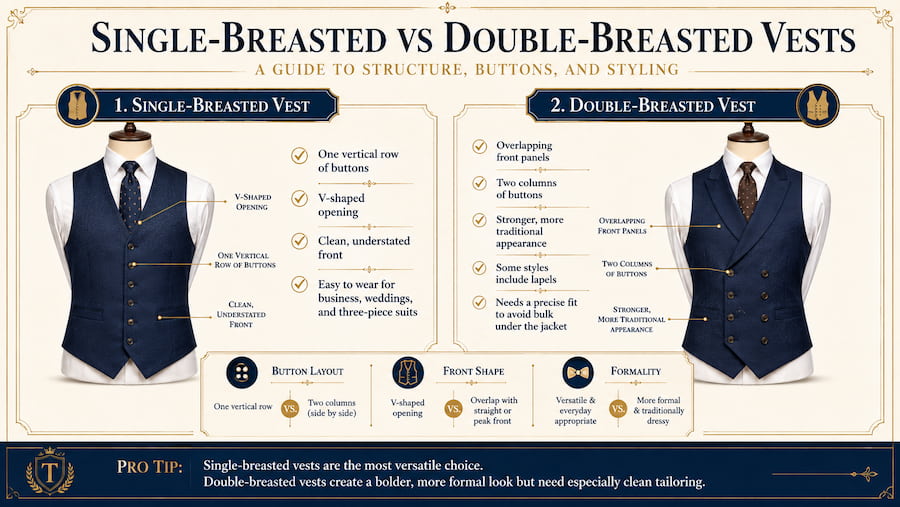
Single-Breasted Vest
This is the most common style.
It usually has:
- One vertical row of buttons
- A V-shaped opening
- A relatively clean, understated front
It is easy to wear for business, weddings, and general three-piece tailoring.
Double-Breasted Vest
A double-breasted vest has overlapping front panels and two columns of buttons.
It creates a stronger and slightly more traditional appearance.
Some versions also include lapels.
Because there is more fabric across the front, the fit needs to be particularly clean so the waistcoat does not create unnecessary bulk underneath the jacket.
What Shirt and Tie Should You Wear With a Vest?
For formal and business occasions, a dress shirt is the safest choice.
Easy shirt colours include:
- White
- Pale blue
- Soft pink
- Restrained stripes
When wearing a tie, it should sit neatly inside the V of the waistcoat.
For weddings and less formal occasions, an open-collar shirt can also work, although the outfit will immediately feel more relaxed.
The more formal the event, the more appropriate a tie becomes.
When Should You Wear a Vest With a Suit?
A vest works particularly well when you want more structure or formality.
Business
A matching three-piece suit works well in professional environments, especially in navy or charcoal.
For conservative workplaces, keep the vest the same colour and fabric as the suit.
Weddings
Weddings offer more freedom.
A groom may choose a contrasting vest to distinguish his outfit, while guests can use subtle colour or texture depending on the dress code.
Formal Dinners and Evening Events
Dark matching waistcoats work particularly well with navy, charcoal, and other deeper suits.
However, adding a regular vest does not automatically turn a normal suit into black-tie attire.
Black Tie
A true black-tie dress code normally requires a tuxedo or dinner suit.
Depending on the style, formal eveningwear may include a low-cut evening waistcoat or cummerbund.
A standard business vest worn under a black suit is not the same thing.
Can You Wear a Vest Without the Jacket?

Yes, but the result becomes less formal.
After removing the jacket at a wedding, dinner, or social event, remaining in the matching waistcoat can still look polished because it is part of the original three-piece suit.
A vest can also be styled intentionally without a jacket for smart-casual outfits.
For example:
- Vest + dress shirt + tailored trousers
- Textured vest + chinos
- Tweed vest + dark denim
- Linen vest + lightweight trousers
For casual styling, the vest should look intentionally chosen as a separate piece rather than as though the jacket has simply been forgotten.
Can You Wear a Vest With Jeans or Chinos?
Yes, although a more casual vest usually works better than the formal matching waistcoat from a business suit.
Good options include:
- Tweed
- Linen
- Cotton
- Textured wool
- Subtle checks
A highly formal satin-backed waistcoat may feel out of place with denim, while a textured brown, grey, or patterned vest can work naturally.
How Should You Choose a Vest for Your Body Type?

Body type should influence fit and proportion rather than determine whether you can wear a vest at all.
Broad or Athletic Build
Choose enough room through the chest and clean, high armholes.
Avoid pulling the back adjuster excessively tight.
Slim Build
A closely fitted or double-breasted vest can add visual structure.
Avoid oversized armholes and excessive fabric around the waist.
Fuller Midsection
Choose a vest that follows the body without squeezing it.
Moderate V openings and clean vertical lines can create a balanced appearance.
Avoid treating the vest like compression clothing.
Shorter Frame
Correct body length is particularly important.
A properly proportioned V opening and button placement can help create a cleaner vertical line, while an overly long vest may make the torso look shorter.
How Do You Wear a Vest in Warm Weather?
Adding a vest means adding another layer, so fabric weight becomes especially important in Bangkok and other warm climates.
Good options include:
- Tropical wool
- Lightweight worsted wool
- Linen
- Linen blends
- Lightweight cotton blends
For daytime weddings and outdoor events, lighter colours such as beige, light grey, tan, and soft blue can also create a less visually heavy outfit.
The material matters just as much as the colour. A lightweight dark wool suit can sometimes feel more comfortable than a heavy suit in a pale colour.
If you are deciding which material will work best for the climate and occasion, our guide to suit fabrics explains how wool, linen, cotton, and other options differ in breathability, structure, and appearance.
What Are the Most Common Suit Vest Mistakes?
Wearing the Vest Too Short
If the vest exposes the shirt or trouser waistband, the clean line between the torso and trousers is broken.
Buttoning the Bottom Button
The lowest button of a traditional single-breasted waistcoat is normally left undone.
Wearing the Vest Too Tight
Pulling around the buttons and strong horizontal wrinkles are signs that the vest needs more room.
Wearing the Vest Too Loose
Excess material around the chest and waist removes the clean structure the garment is supposed to provide.
Mixing Too Many Patterns
A patterned suit, patterned vest, patterned shirt, and patterned tie can compete for attention.
Usually, one strong pattern is enough.
Creating Too Much Bulk at the Waist
A large belt buckle or excess shirt fabric can create a visible bump beneath the waistcoat.
If possible, trousers worn with a three-piece suit should sit cleanly without unnecessary bulk around the waistband.
Choosing the Wrong Level of Formality
A casual tweed vest and a formal evening waistcoat serve very different purposes.
Make sure the vest belongs with the rest of the outfit.
What Does a Tailor Check When Fitting a Vest?
A properly fitted waistcoat needs to work with the shirt, trousers, and jacket rather than fitting well only when viewed on its own.
| Fit Area | What the Tailor Checks | Signs of Poor Fit |
|---|---|---|
| Chest Fit | The front should lie smoothly across the chest and sit cleanly around the armholes. | Pulling around the buttons or gaps around the armholes |
| Waist Fit | The vest should follow the torso closely without feeling overly tight. | Excess fabric looks boxy, while too little fabric causes pulling |
| Body Length | The vest should be long enough to completely cover the trouser waistband. | Shirt or waistband showing beneath the vest |
| Trouser Rise | The trousers and waistcoat should meet naturally to create one continuous line. | Very low-rise trousers can create a visible gap between the vest and trousers |
| Neckline | The neckline should sit flat and cleanly against the shirt. | Gaping or standing away from the shirt |
| Back Fit | The back should remain smooth without relying too heavily on the adjuster. | Bunching, strong wrinkles, or an adjuster pulled excessively tight |
| Jacket Compatibility | The jacket should still close comfortably and sit cleanly over the vest. | Jacket pulling, distortion, or unnecessary bulk around the torso |
The jacket, vest, trousers, and shirt therefore need to work together as one outfit. If you want to understand those proportions in more detail, our guide to how a suit should fit covers the jacket, trousers, shoulders, sleeves, and overall balance of a properly fitted suit.
Should You Choose a Two-Piece or Three-Piece Suit?
The better option depends on how often you expect to wear the additional layer.
A two-piece suit gives you:
- Fewer layers
- A slightly less formal appearance
- More comfort in very warm weather
- Simple everyday versatility
A three-piece suit gives you:
- A more formal appearance
- More visual structure
- An additional styling option
- A polished appearance after removing the jacket
One useful advantage of buying a three-piece suit is that you do not have to wear all three pieces every time.
You can wear the full suit for weddings or formal occasions, then leave the vest at home and wear the same jacket and trousers as a conventional two-piece suit.
If you are still deciding between different constructions, our guide to suit types explains the differences between three-piece, single-breasted, double-breasted, tuxedo, and other common suit styles.
How Do You Choose the Right Vest for Your Suit?
Start with the occasion.
For business and formal wear, a matching waistcoat is generally the safest choice.
For weddings and social occasions, you can introduce more contrast through colour, texture, or pattern.
Then check the fit.
The vest should:
- Sit close without pulling
- Completely cover the waistband
- Lie flat at the chest and neckline
- Allow comfortable movement
- Fit cleanly beneath the jacket
Finally, consider how the vest works with the entire outfit rather than choosing it separately.
A successful combination should connect the:
- Suit colour
- Fabric
- Shirt
- Tie
- Trousers
- Shoes
- Dress code
For most men buying their first vest, a matching single-breasted waistcoat made from the same fabric as the jacket and trousers is still the most versatile place to start.
Conclusion
Wearing a vest under a suit works best when the vest feels like an intentional part of the outfit rather than an additional accessory.
The most important details are fit and proportion. The vest should cover the trouser waistband completely, sit close to the torso without pulling, lie flat around the chest and armholes, and fit comfortably beneath the jacket.
For a traditional three-piece suit, matching the jacket, vest, and trousers remains the most versatile approach. Contrasting waistcoats can introduce more personality for weddings, dinners, and less conservative occasions when the colours and fabrics are carefully coordinated.
At Michael Tailors, clients can compare matching and contrasting fabrics while having the jacket, vest, and trousers considered as one complete outfit. Working with a Bangkok suit tailor also allows the vest length, chest, waist, trouser rise, and jacket fit to be adjusted together rather than treating each piece separately.
Frequently Asked Questions
What Is the Difference Between a Vest and a Waistcoat?
In tailoring, they generally describe the same garment. “Vest” is more commonly used in American English, while “waistcoat” is more common in British English.
Should a Suit Vest Cover the Trouser Waistband?
Yes. A properly fitted vest should completely cover the waistband so that no shirt fabric appears between the vest and trousers.
Should You Leave the Bottom Button of a Suit Vest Undone?
For a traditional single-breasted waistcoat, the lowest button is normally left undone. Other vest designs may follow different fastening conventions.
Should You Unbutton a Vest When Sitting Down?
A classic single-breasted waistcoat normally remains fastened while sitting, with the bottom button already left undone.
If sitting causes significant pulling across the stomach, the vest may be too tight.
Should a Vest Match the Jacket and Trousers?
For a traditional three-piece suit, yes. The vest is normally made from the same cloth as the jacket and trousers.
Contrasting waistcoats can work particularly well for weddings and less conservative social occasions.
Can You Wear a Vest Without a Jacket?
Yes. A matching waistcoat can still look polished after the jacket is removed at a wedding, dinner, or social event.
A separate textured vest can also be intentionally styled without a jacket for smart-casual outfits.
Can You Wear a Vest Without a Tie?
Yes, especially for less formal occasions.
For traditional business settings, formal weddings, and dressier events, a tie usually creates the more appropriate look.
Can You Wear a Suit Vest With Jeans?
Yes, although casual or textured vests usually work better with jeans than the formal matching waistcoat from a business suit.
Tweed, linen, cotton, and textured wool are easier to combine with denim.
Is a Three-Piece Suit More Formal Than a Two-Piece Suit?
Generally, yes. The additional waistcoat gives the outfit more structure and creates a more traditional tailored appearance.
Can You Wear a Regular Suit Vest for Black Tie?
A regular suit vest does not make a normal suit appropriate for black tie.
Traditional black tie normally requires a tuxedo or dinner suit and may include an appropriate evening waistcoat or cummerbund depending on the style.

More Articles
Getting a Suit Made in Bangkok on a Short Trip: Real Customer Stories
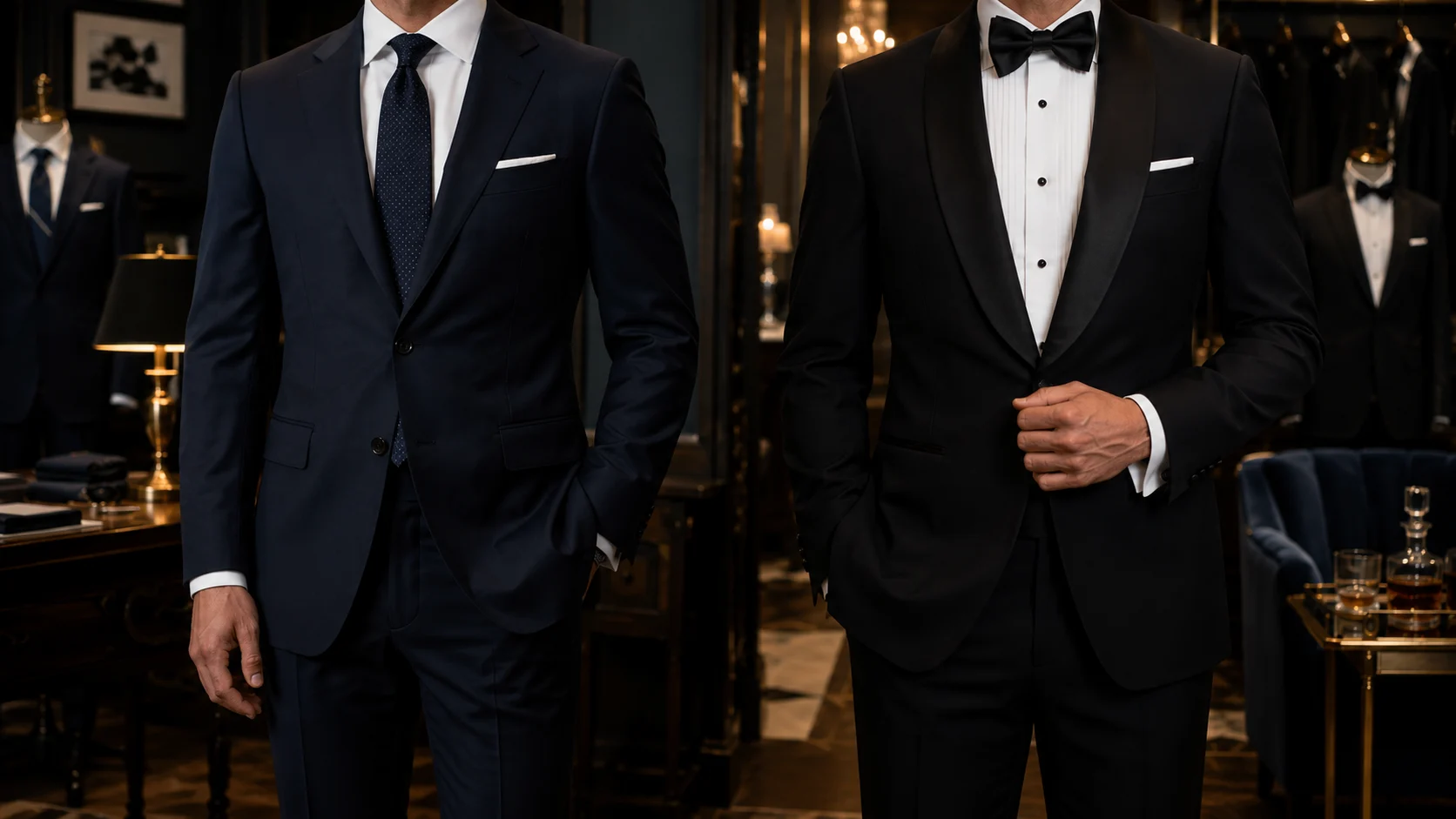
Suit vs Tuxedo: Key Differences and When to Wear Each One